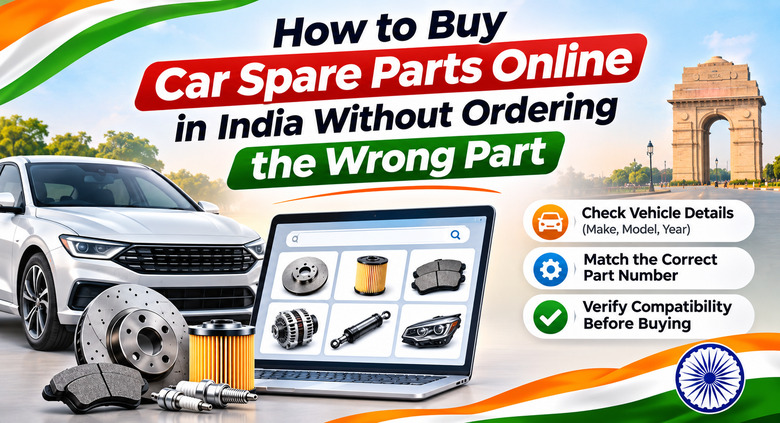
How to Buy Car Spare Parts Online in India Without Ordering the Wrong Part
19 November 2026
A Maruti Suzuki Dzire headlight, Hyundai Creta AC compressor or Volkswagen Polo gearbox may look like the correct replacement in an online listing. But what happens when the mounting points do not align, the electrical connectors differ or the part belongs to another vehicle generation?
You could end up paying for something your mechanic cannot install, losing money on return shipping or leaving your vehicle off the road longer than expected.
Buying car spare parts online in India can save considerable time, particularly when sourcing used original components, comparing replacement prices or searching for parts that local shops do not stock. However, successful purchases depend on more than finding a familiar model name and an attractive price.
Partfinder India helps car owners and repair businesses connect with spare-parts suppliers and compare quotations for new and used components. Before requesting or accepting a quote, understanding how to identify the correct part can make all the difference.
This guide explains what experienced spare-parts buyers check before ordering, which details sellers need and how to avoid expensive compatibility mistakes.
How Can You Buy the Correct Car Spare Part Online in India?
The safest approach is to identify your vehicle precisely, confirm the required component using its original part number or manufacturer catalogue, verify compatibility with the seller, and agree on the part's condition, total price, warranty and return terms before payment.
Follow these seven essential checks:
- Identify your vehicle: Confirm its model, manufacturing year, generation, engine, transmission and variant.
- Identify the failed component: Establish which part actually needs replacement through appropriate diagnosis.
- Find the part number: Check the existing component, manufacturer catalogue or authorised service records.
- Verify compatibility: Compare the part number, mounting points, connectors, specifications and equipment configuration.
- Choose the condition: Decide whether genuine new, OEM/OES, aftermarket, used original or professionally reconditioned is suitable.
- Compare supplier quotations: Review the final delivered cost, evidence of condition, warranty and return policy.
- Inspect before installation: Have the supplied component checked against the old part and vehicle requirements before fitting.
Not every purchase needs the same level of investigation. A simple interior trim clip is considerably less complicated than an engine control module, automatic gearbox or electronically controlled headlight.
The more expensive, technical or safety-critical the component, the more important these checks become.
Why Do Buyers Receive the Wrong Car Spare Parts Even After Selecting the Correct Model?
A vehicle manufacturer's model name can remain unchanged for years while its mechanical systems, electronics and body design undergo substantial changes.
Consider somebody searching for a Maruti Suzuki Dzire engine component.
The all-new Dzire introduced in November 2024 uses a 1.2-litre Z-Series petrol engine, whereas the preceding generation used a different engine family. An engine-related component advertised simply as fitting the "Maruti Dzire" should never be assumed to work across these generations.
Similarly, Hyundai Creta variants can differ in headlight technology, daytime running lights, sensors and electronic equipment. Two lamps may be intended for the same broad model range but have different connectors or internal components.
These are not unusual complications. They reflect how modern vehicles are designed and upgraded.
The eight vehicle details that matter before buying spare parts
| Vehicle information | Why suppliers need it |
| Make and model | Identifies the vehicle family |
| Manufacturing year | Helps locate the correct production specification |
| Generation or facelift | Distinguishes older and revised designs |
| Engine capacity and code | Identifies engine-specific components |
| Fuel type | Separates petrol, diesel and other configurations |
| Transmission | Distinguishes manual, AMT, CVT, DCT and other systems |
| Variant or trim | Helps identify equipment and electrical differences |
| VIN or chassis number | Enables precise catalogue verification where supported |
A registration date is not necessarily the same as a manufacturing date.
For example, a car first registered in January may have been manufactured during the previous year. If a manufacturer changed a component during that production period, the difference could matter.
Expert buying tip: When a component is affected by a facelift, engine update or production change, ask suppliers to confirm the relevant production date or VIN range rather than relying only on the year shown in the registration certificate.
Check the VIN, Chassis Number and Original Part Number Before Ordering
A car's Vehicle Identification Number (VIN), commonly referred to as the chassis number in India, is one of the most useful references for identifying compatible replacement parts.
It contains manufacturer-encoded vehicle identification information and can help an authorised parts catalogue identify the vehicle's original configuration.
However, a VIN alone is not a universal guarantee of compatibility. It must be checked against a suitable manufacturer catalogue, and previously modified or replaced components may require additional inspection.
Where can you find your car's VIN?
Depending on the manufacturer and model, you may find it:
- On the vehicle identification plate or chassis stamping.
- Near the lower windscreen area.
- On a door-frame identification label.
- In vehicle documentation or authorised service records.
The location varies by vehicle. Consult the owner's manual if you are unsure.
Share the VIN privately with a legitimate supplier when necessary. Avoid publicly posting registration documents or other personal information.
Why is the original part number so important?
Most manufacturers identify replacement components through catalogue part numbers.
These are more precise than general descriptions such as "Swift radiator", "Honda City starter" or "Creta left headlight".
However, a number moulded into the casing is not always the complete orderable spare-part number. It could be a casting number, supplier identification code or internal manufacturing reference.
For example, an electronic control unit may have several visible numbers identifying the hardware, software revision and manufacturer. Matching only one of these numbers might not establish that the replacement will function correctly.
Where possible, ask the seller to verify the complete service-part number against a manufacturer catalogue.
Also ask whether the original number has been superseded by a revised replacement number. Manufacturers sometimes replace older part references with updated compatible versions.
A matching number is valuable evidence, but confirmed compatibility matters more than simply finding identical digits on two labels.
Real Indian Car Examples: Where Compatibility Mistakes Happen
Maruti Suzuki Dzire: The Wrong Generation Can Mean the Wrong Component
Imagine ordering an engine component for a 2023 Dzire after finding an online listing labelled "Dzire 2023–2025".
That year range crosses an important generation change.
The November 2024 Dzire introduced a different engine family and new body styling. Some components from the earlier model will therefore not be appropriate for the newer generation.
For engine-related parts, verify the engine family and exact catalogue reference. For exterior components, confirm whether the car belongs to the older or all-new body design.
Do not accept a broad compatibility range without supporting evidence.
Hyundai Creta: Headlight Appearance Is Not Enough
A Creta owner with a damaged headlight might receive several quotations for what appears to be the same component.
However, lighting equipment can differ by model generation and variant, including projector and LED configurations.
Before ordering, check:
- Whether the car is the pre-facelift or revised version.
- The exact headlight assembly type.
- Left-hand or right-hand location.
- Connector shape and pin configuration.
- Integrated DRLs, indicators or additional lighting functions.
- The manufacturer's compatible part reference.
The outer shape alone cannot establish whether the assembly will operate correctly.
Volkswagen Polo: Engine and Gearbox Combinations Matter
A buyer searching for a Volkswagen Polo gearbox may find listings for several engine and transmission combinations.
A transmission from a different Polo variant should not be considered compatible merely because its casing looks similar.
The transmission code, mounting arrangement, driveshaft connections, clutch or torque-converter interface, electronic controls and gear ratios may all matter.
For a used gearbox, request its identification code and donor-vehicle details, then have a qualified workshop confirm interchangeability.
Tata Nexon: Electronics Can Make a Physical Match Insufficient
Consider replacing a door mirror assembly on a Tata Nexon.
Depending on the particular model and variant, the mirror may include electrical adjustment, indicator lighting, power folding or other functions.
A replacement housing might physically attach to the door while lacking the correct electrical equipment.
The same caution applies to cameras, sensors, infotainment components and electronic modules across many modern Indian cars.
The lesson is simple: a component that fits physically is not necessarily a component that works correctly.
Genuine, OEM, Aftermarket or Used: Which Car Spare Parts Should You Buy?
One of the biggest advantages of shopping for car spare parts online in India is the opportunity to compare different buying options.
However, the terminology used by sellers can sometimes be confusing.
Understand the differences before comparing prices
| Part type | What it means | What to verify |
| Genuine new | Supplied under the vehicle manufacturer's branding or authorised parts system | Packaging, authenticity, correct part number and applicable warranty |
| OEM/OES | Supplied by an original-equipment manufacturer or service-parts supplier; terminology varies | Manufacturer identity, actual specification and compatibility |
| Aftermarket | Manufactured and marketed as a replacement outside the vehicle brand's genuine-parts channel | Brand reputation, specifications, quality and warranty |
| Used original | Previously fitted original component recovered from another vehicle | Condition, donor vehicle, damage, compatibility and return terms |
| Reconditioned | Used component that has undergone some form of repair or refurbishment | Work performed, parts replaced, testing and warranty |
An OEM label does not automatically establish that a component is identical to the one sold in the vehicle manufacturer's box.
Likewise, not all aftermarket components offer the same quality.
A reputable replacement brake component and an unbranded component of uncertain origin should not be treated as equivalent simply because both fit the same vehicle.
When are used original parts worth considering?
Used original parts can be a practical option for certain body and interior components.
Examples include:
- Doors and tailgates.
- Exterior body panels.
- Interior trim pieces.
- Parcel shelves and selected seating components.
- Certain mechanical assemblies, subject to inspection.
- Selected lighting assemblies, after checking condition and operation.
For a used door, inspect the mounting edges, hinge locations, corrosion, previous repairs and whether the quoted price includes the glass, lock, wiring and window regulator.
A door advertised as "complete" may not contain every component you expect.
Which car parts deserve extra caution?
Brakes, steering components, airbags, seatbelt pretensioners and other safety-critical systems require particularly careful consideration.
Avoid purchasing unknown, damaged or previously deployed safety components. Use replacement parts and procedures that comply with the vehicle manufacturer's requirements and seek qualified professional installation.
High-voltage EV and hybrid components also require specialist handling, diagnosis and installation.
Choose the condition according to the component's safety requirements and total repair risk, not just the lowest advertised price.
How to Compare Car Spare Parts Prices Online Without Getting Misled
The cheapest quotation is not always the least expensive repair.
Suppose you need an AC compressor for a Hyundai i20.
One supplier offers a low-priced used compressor, while another offers a tested original unit at a higher price.
The lower quote might initially look attractive. But what if the cheaper compressor has no operating evidence, does not include the required pulley arrangement or develops a fault shortly after installation?
You may end up paying twice for refrigerant recovery, system servicing and installation labour.
Compare the complete cost, not just the component price
Consider this illustrative example, not actual market quotations:
| Cost element | Supplier A | Supplier B |
| Quoted part price | ₹5,000 | ₹6,400 |
| Delivery | ₹700 | Included |
| Warranty | Not offered | Limited written warranty |
| Testing evidence | Not supplied | Supplied |
| Return conditions | Unclear | Confirmed in writing |
Supplier B costs more upfront, but the supporting evidence and clearly defined terms may make it the better purchase.
This does not mean a higher price guarantees better quality. It means the comparison should account for risk as well as price.
Before ordering, confirm whether the price includes GST, packaging and delivery, and ask for an appropriate invoice.
For large items such as engines, gearboxes, bumpers or doors, confirm freight charges and the procedure for reporting transport damage.
What Should You Check Before Buying a Used Engine or Gearbox Online?
Used engines and transmissions demand more detailed checks because an incorrect or defective unit can create substantial additional repair costs.
Buying a used engine
Before agreeing to purchase, request:
- The engine code and confirmation of compatibility.
- The donor vehicle's model, generation and relevant specification.
- Clear photographs of the actual engine being supplied.
- Evidence of running condition or relevant diagnostic testing, where available.
- Information about overheating, oil leaks or previous internal repairs.
- Clarification of which accessories are included.
- Written warranty, return and installation conditions.
An engine advertised as "complete" might be sold without the alternator, starter motor, turbocharger, engine wiring or other accessories.
Do not assume these items are included.
Where the engine number is relevant to registration or repair documentation, establish the applicable legal and documentation requirements before purchase.
Buying a used automatic gearbox
For an automatic transmission, check the complete transmission code and whether any associated control modules, torque converter, mechatronic assembly or other necessary components are included.
Different automatic transmission types may require different fluids, electronic adaptations and installation procedures.
Ask the fitting workshop to confirm compatibility before committing to the purchase.
A gearbox being described as "tested" is not sufficient by itself. Ask what testing was performed and whether evidence is available.
Ten Common Mistakes When Ordering Car Parts Online in India
1. Ordering by model name alone
Problem: The replacement belongs to another generation, engine or variant.
Better approach: Confirm vehicle specifications and the exact part number.
2. Assuming every part from the same year fits
Problem: Production changes or facelift updates may introduce different components.
Better approach: Check the manufacturing date and applicable VIN range.
3. Trusting photographs without checking numbers
Problem: Similar-looking parts can differ internally.
Better approach: Compare part references, dimensions, mounting points and connectors.
4. Replacing components without proper diagnosis
Problem: The purchased component may not be responsible for the fault.
Better approach: Confirm the diagnosis before ordering expensive parts.
5. Buying electronic modules without checking programming requirements
Problem: The module fits but cannot operate correctly without compatible software, coding or adaptation.
Better approach: Verify hardware, software and installation requirements with a specialist.
6. Ignoring the exact condition of used parts
Problem: A low-priced component arrives damaged, incomplete or heavily worn.
Better approach: Request recent photographs, testing evidence and a clear description.
7. Comparing only the advertised price
Problem: Delivery, taxes, additional accessories or installation costs make the purchase more expensive.
Better approach: Compare complete delivered and fitted costs where relevant.
8. Assuming a warranty covers everything
Problem: Labour, transport, diagnostics or consequential damage may be excluded.
Better approach: Read the actual terms, exclusions and claim procedure.
9. Ordering before confirming return eligibility
Problem: An electrical or special-order component may be difficult to return after installation.
Better approach: Ask what happens if professional inspection identifies an incorrect part.
10. Failing to inspect the delivery before installation
Problem: Damage or discrepancies are discovered after fitting.
Better approach: Check labels, condition and compatibility immediately upon receiving the package.
How to Confirm a Car Part's Compatibility Before Making Payment
An experienced spare-parts buyer should seek three forms of confirmation whenever practical.
First: Catalogue confirmation
Ask whether the seller has checked the component against the appropriate vehicle identification information or manufacturer parts catalogue.
Second: Physical confirmation
Request photographs showing relevant labels, mounting points, connectors and the actual supplied component.
For body panels, compare major contours and mounting locations. For electrical parts, confirm the connector and pin configuration.
Third: Functional and installation confirmation
Ask whether the component requires coding, programming, calibration, additional accessories or specialist fitting.
For example, replacing certain camera-equipped windscreens or ADAS-related components may require calibration after installation.
Matching a physical component does not eliminate these procedures.
If a seller cannot reasonably establish compatibility, ask for further evidence before paying.
What Photos Should You Send to a Spare Parts Supplier?
Good photographs can reduce misunderstandings, especially when ordering second-hand or difficult-to-identify components.
For most enquiries, provide a photograph of the damaged component, its visible part-number label and the surrounding installation area.
For specific components, additional angles can be valuable.
| Component | Useful photographs and information |
| Headlight | Front lens, rear housing, label and connectors |
| Door mirror | Housing, mounting base, electrical plug and features |
| Radiator | Inlet/outlet positions, mounting points and dimensions |
| Alternator | Label, pulley, mounting ears and connector |
| AC compressor | Part label, pulley arrangement, ports and connectors |
| ECU | Complete identification label and connector arrangement |
| Gearbox | Identification code, casing and relevant mounting details |
| Bumper | Front and rear views, sensor holes and mounting tabs |
A photograph is supporting evidence, not a replacement for part-number verification.
If the original component has already been removed, ask your garage to retain its identification labels or take clear photographs before disposal.
Buying Car Parts for Older, Discontinued or Hard-to-Find Models in India
Finding replacement parts can become more challenging when a vehicle is no longer manufactured in India or when a particular variant was sold in relatively small numbers.
Buyers maintaining older Ford, Chevrolet, Fiat, Renault, Volkswagen or other vehicles may encounter limited local stock for certain components.
A part unavailable at one shop is not necessarily unavailable throughout India.
However, buying an apparently similar component from another model is not automatically a safe solution.
Some manufacturers use shared platforms, engines and parts across different vehicles. This can create genuine interchangeability opportunities, but the equivalence must be confirmed through catalogue information and technical specifications.
For example, a seller might suggest that a sensor, alternator or mechanical component from one related model can replace a part in another.
Request the relevant cross-reference number and have the proposed substitution checked by a qualified professional.
Do not rely solely on statements such as "same engine", "same company" or "universal fitting".
How to Find Car Spare Parts Suppliers Online in India
Visiting multiple spare-parts shops may not be practical when looking for an uncommon component.
Online spare-parts marketplaces can help buyers communicate their requirements to suppliers and compare available options.
The key is to submit an accurate enquiry.
Buying through Partfinder India
Visit Partfinder India and start by selecting your vehicle details.
Step 1 — Select your car
Provide the make, model and year of the vehicle.
Step 2 — Choose the required spare part
Identify the component and choose whether you prefer new or used parts, or are willing to consider either.
Step 3 — Submit your contact details
Complete the enquiry with the requested contact information so suppliers can respond.
Step 4 — Compare quotations
Review supplier responses and confirm the exact component, condition, compatibility, price and availability.
Step 5 — Finalise the purchase with your chosen supplier
Discuss payment, delivery, warranty and return arrangements directly with the seller before proceeding.
The enquiry process is designed to help buyers explore supplier options without having to approach every seller individually.
However, buyers should still perform their own compatibility and quality checks. A quotation or listing does not, by itself, guarantee suitability for a particular vehicle.
Questions You Should Ask Every Seller Before Ordering
Before making payment, send the following questions to the supplier:
- Is this the exact component for my vehicle's VIN, engine and variant?
- Can you confirm the manufacturer or compatible replacement part number?
- Is the part genuine new, aftermarket, used original or reconditioned?
- Are the photographs of the actual item being supplied?
- Is it tested, and can you provide supporting evidence?
- Are brackets, connectors, sensors or accessories included?
- What is the final price including taxes and delivery?
- Is there a written warranty or inspection period?
- What happens if the part arrives damaged or is confirmed incompatible?
- Is specialist programming, calibration or installation required?
A useful supplier should be able to explain what they know about the component and identify any limitations.
Be particularly cautious when the seller refuses to share necessary identification information, makes unsupported guarantees or pressures you to pay before answering basic compatibility questions.
What Should You Do When Your Spare Part Arrives?
Do not immediately install an expensive component simply because the package has arrived.
Start with an inspection.
Check that the supplied part matches the agreed condition, description and identification details.
Inspect the package for transport damage and photograph any visible damage before discarding the packaging.
Compare the replacement with the removed component where possible. Check electrical connectors, mounting locations, relevant dimensions and included accessories.
If the part requires bench testing or specialist inspection, arrange this before installation in accordance with the seller's agreed terms.
For electronic modules, engines, gearboxes and other major assemblies, confirm that the workshop has reviewed the installation requirements.
Keep the invoice, payment record and seller's written commitments.
If the part is damaged, incomplete or clearly incompatible, contact the seller promptly rather than modifying it in an attempt to make it fit.
Why Proper Diagnosis Matters Before Buying Replacement Parts
Sometimes the biggest buying mistake happens before the online search even begins.
A car owner identifies a symptom, assumes one component has failed and orders a replacement without confirming the cause.
Consider an AC system that stops cooling properly while the vehicle is stationary.
The owner might immediately search for a replacement compressor.
However, poor cooling can also involve condenser airflow, cooling-fan operation, refrigerant quantity or control-system faults.
Replacing the compressor without investigating the actual cause may not restore proper cooling.
A similar problem occurs when a car fails to start.
The starter motor might be suspected, but the underlying issue could involve the battery, electrical connections, starter-control circuit or another system.
A stored diagnostic fault code is also not automatic proof that the named sensor must be replaced.
The correct buying sequence is diagnosis first, component identification second and supplier selection third.
This approach can prevent unnecessary purchases and repeat repair work.
Are Online Car Spare Parts Cheaper Than Local Shops in India?
Online purchasing can make it easier to compare supplier quotations and discover parts outside your immediate area.
But it is not possible to say that online parts are always cheaper.
For a common service item, a nearby authorised distributor or established independent parts shop may offer a competitive price with faster availability.
For an unusual used body panel or discontinued component, a supplier in another city may have suitable stock that local shops cannot source quickly.
The best buying option depends on the exact component, its condition, transport costs, installation requirements and the credibility of the seller.
For urgent repairs, also consider the financial impact of vehicle downtime.
A replacement that costs slightly more but is correctly identified and available immediately could be more valuable than a lower-priced component requiring uncertain shipping and compatibility checks.